

Sumitomo Rubber’s Proprietary Software Technology SENSING CORE Adopted in China’s Commercial EVs:Tire Load Detection Feature to Debut
Mar. 04. 2026
DUNLOP (Company name: Sumitomo Rubber Industries, Ltd.; President and CEO: Satoru Yamamoto) has been globally expanding its proprietary sensing technology “SENSING CORE” designed to detect the condition of tires, vehicles, and road surfaces, and is pleased to announce that the “tire load detection” and “tire air pressure detection” functions of SENSING CORE have been adopted by Chongqing Ruichi Automotive Industry Co., Ltd. (hereafter “Ruichi”), a major player in China’s commercial EV market, for its new commercial EV model “Ruichi C5.”※ This represents SENSING CORE’s first commercial deployment in China and marks our first introduction of the tire load detection technology in the global market.
The tire load detection function finds changes in cargo load volume and placement in real time and provides the results to the vehicle control system. It reduces the “unstable feel in driving when starting, stopping, or turning” caused by changes in the loading state, thereby contributing to reduced driver burden and stable cargo transport. This function is also scheduled for implementation in other Ruichi models going forward. To this end, DUNLOP will continue its efforts to expand its adoption.
* Ruichi C5 official website (in Chinese): https://www.rc-ev.com/cms/a/C5QYZC.html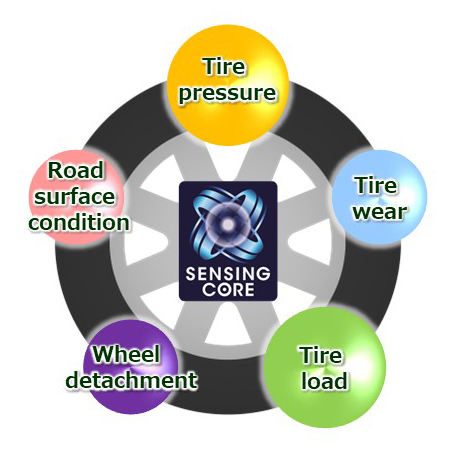
Five functions of SENSING CORE
■ What is SENSING CORE
SENSING CORE is a software technology that analyzes wheel speed data generated by tire rotation, together with CAN data (vehicle control information) transmitted through the vehicle’s control system, to detect various tire and road conditions, including tire pressure, tire wear, tire load, and signs of potential wheel detachment, without the need to use additional sensors.
■ Tire load detection (Newly added feature)
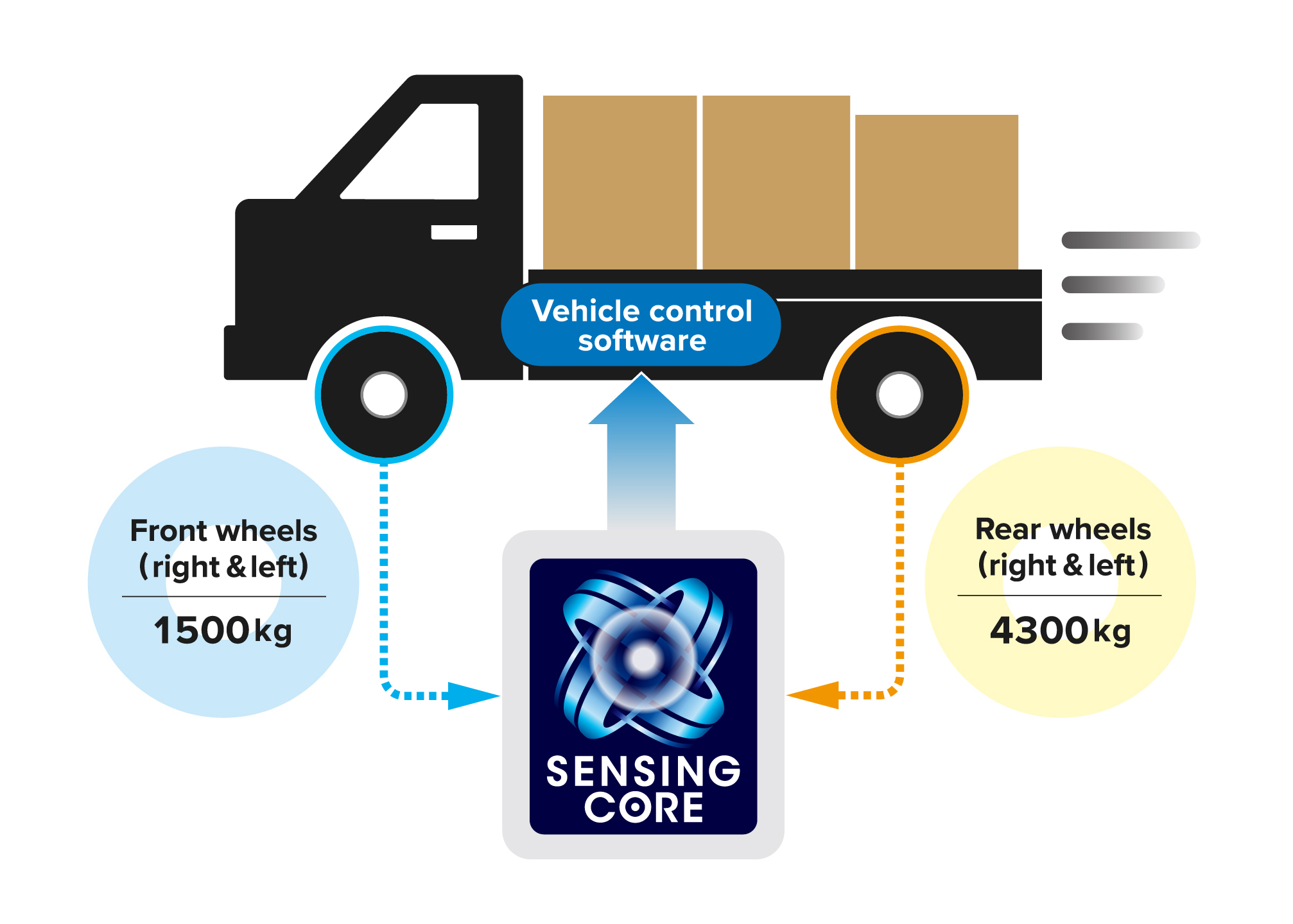
The tire load detection function equipped on new commercial EV Ruichi C5 detects the total load on the left and right tires in real time for the front and rear axles, respectively, according to changes in load volume and position. The detected load data is then relayed to the vehicle control system and used to optimize torque output during acceleration/deceleration and brake control based on the current load state. This delivers smooth, stable ride quality that remains unaffected by load changes, even during frequent loading/unloading in city delivery settings.
[Improvement effects through tire load detection]
The introduction of tire load detection is expected to provide various advantages, such as improved driving stability and feel in urban delivery settings, in addition to better energy efficiency.

Future prospects
DUNLOP is pursuing the “SMART TYRE CONCEPT” as a development philosophy for tires and related services aimed at delivering high safety and environmental performance for CASE/MaaS applications. At the core of these services is SENSING CORE, which we plan to foster as our fourth major business pillar, alongside tires, sports, and industrial products.
Based on this philosophy, tire load detection is strategically positioned to play a crucial role in implementing and expanding the values of SENSING CORE concretely across the mobility sector, particularly within the commercial vehicle segment. Issues such as frequent starts and stops during urban deliveries and changes in load conditions are common challenges not only in China but throughout Asia, including Japan. Building on this adoption, DUNLOP aims to further expand our presence both in Japan and overseas.
・Company name : Chongqing Ruichi Automobile Industry Co., Ltd.
・Vehicle name : Ruichi C5
・Vehicle model : Small trucks
・Sales launch date : December 2025
・Sales target volume : 20,000 units/year
・Sales region : China
The tire load detection function finds changes in cargo load volume and placement in real time and provides the results to the vehicle control system. It reduces the “unstable feel in driving when starting, stopping, or turning” caused by changes in the loading state, thereby contributing to reduced driver burden and stable cargo transport. This function is also scheduled for implementation in other Ruichi models going forward. To this end, DUNLOP will continue its efforts to expand its adoption.
* Ruichi C5 official website (in Chinese): https://www.rc-ev.com/cms/a/C5QYZC.html
Five functions of SENSING CORE
Background
In urban areas in China, short-distance, frequent delivery services are booming amid growing e-commerce demand while the adoption of autonomous driving and driver assistance features is accelerating. Particularly in vehicles equipped with advanced driver-assistance systems (ADAS), control is usually based on predetermined load conditions. This can lead to discrepancies between actual load conditions and vehicle control, affecting driver comfort and cargo stability. As a result, commercial vehicles now place increased priority on smooth and stable acceleration and deceleration control that is less affected by load conditions.
Ruichi decided to adopt DUNLOP’s tire load detection technology as an effective solution to these challenges. In addition to requiring no additional sensors and allowing installation without modifying existing vehicle configurations, the significant cost advantages were major deciding factors.
Overview of SENSING CORE’s Tire Load Detection technology and value it provides
In urban areas in China, short-distance, frequent delivery services are booming amid growing e-commerce demand while the adoption of autonomous driving and driver assistance features is accelerating. Particularly in vehicles equipped with advanced driver-assistance systems (ADAS), control is usually based on predetermined load conditions. This can lead to discrepancies between actual load conditions and vehicle control, affecting driver comfort and cargo stability. As a result, commercial vehicles now place increased priority on smooth and stable acceleration and deceleration control that is less affected by load conditions.
Ruichi decided to adopt DUNLOP’s tire load detection technology as an effective solution to these challenges. In addition to requiring no additional sensors and allowing installation without modifying existing vehicle configurations, the significant cost advantages were major deciding factors.
Overview of SENSING CORE’s Tire Load Detection technology and value it provides
Schematic diagram of tire load detection
■ What is SENSING CORE
SENSING CORE is a software technology that analyzes wheel speed data generated by tire rotation, together with CAN data (vehicle control information) transmitted through the vehicle’s control system, to detect various tire and road conditions, including tire pressure, tire wear, tire load, and signs of potential wheel detachment, without the need to use additional sensors.
■ Tire load detection (Newly added feature)
The tire load detection function equipped on new commercial EV Ruichi C5 detects the total load on the left and right tires in real time for the front and rear axles, respectively, according to changes in load volume and position. The detected load data is then relayed to the vehicle control system and used to optimize torque output during acceleration/deceleration and brake control based on the current load state. This delivers smooth, stable ride quality that remains unaffected by load changes, even during frequent loading/unloading in city delivery settings.
[Improvement effects through tire load detection]
The introduction of tire load detection is expected to provide various advantages, such as improved driving stability and feel in urban delivery settings, in addition to better energy efficiency.
Future prospects
DUNLOP is pursuing the “SMART TYRE CONCEPT” as a development philosophy for tires and related services aimed at delivering high safety and environmental performance for CASE/MaaS applications. At the core of these services is SENSING CORE, which we plan to foster as our fourth major business pillar, alongside tires, sports, and industrial products.
Based on this philosophy, tire load detection is strategically positioned to play a crucial role in implementing and expanding the values of SENSING CORE concretely across the mobility sector, particularly within the commercial vehicle segment. Issues such as frequent starts and stops during urban deliveries and changes in load conditions are common challenges not only in China but throughout Asia, including Japan. Building on this adoption, DUNLOP aims to further expand our presence both in Japan and overseas.
・Company name : Chongqing Ruichi Automobile Industry Co., Ltd.
・Vehicle name : Ruichi C5
・Vehicle model : Small trucks
・Sales launch date : December 2025
・Sales target volume : 20,000 units/year
・Sales region : China