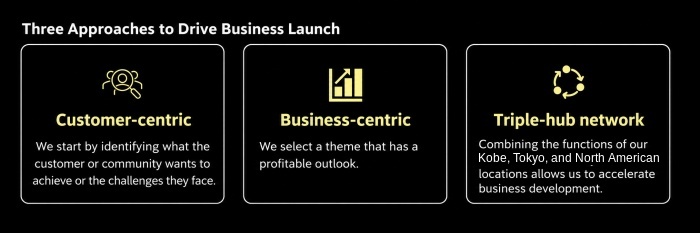
The Innovation & Business Development Department is a team of specialists that creates new businesses based on the challenges faced by communities and customers by combining material, design, analysis, and other technologies developed by Sumitomo Rubber Industries with external knowledge and networks. The department handles everything from generating ideas to building hypotheses, carrying out proofs of concept (PoCs), and preparing for business launch in collaboration with internal and external partners.
Our role is to bring businesses to life that will serve as a future pillar of revenue by identifying customers’ challenges, building business hypotheses, carrying out PoCs, and making decisions based on the stage-gate process. We assess customers, markets, profitability, and societal relevance step by step and focus on themes with high potential. We also contribute to creating an organizational culture that promotes continuous learning by taking on challenges.
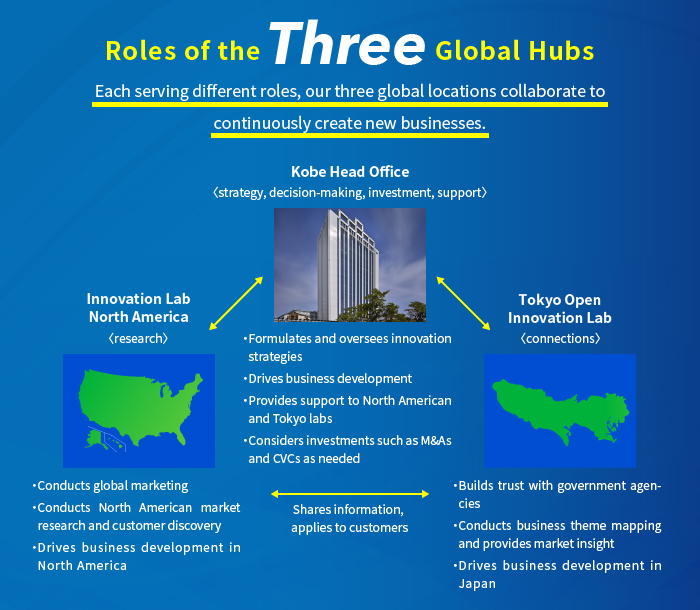
Our Kobe head office formulates strategies, makes business development decisions, and connects internal technologies, talent, and budgets. Tokyo Open Innovation Lab drives PoCs and launches in Japan in collaboration with the national and local governments, universities, other companies, and startups. Innovation Lab North America researches local customer issues and markets, and develops global business opportunities through a network of universities, companies, investors, and others.
The Innovation & Business Development Department manages projects that aim to solve a wide range of societal problems.
Note: The development information described below is meant to be used as an example of expected use. It does not indicate feasibility of practical application or represent expected performance.
1. 3D Printing Rubber—Softness in Almost Any Shape
2. Floating Oyster Farming System—Adapting Farms to Changes in the Ocean Environment
3. Tsunami Evacuation Float—New Evacuation Method for People Unable to Escape
4. Agricultural Reservoir Flood Control System—From Monitoring to Prevention
5. Wireless Power Transfer System—Powering Mobility from Roads
6. Airlift Pump—Moving Water and Resources with the Power of Air
7. High-Performance Floor Coating Solutions—Enhancing the Value of Facilities from the Floor Up
8. Seismic and Wind Damper—Reducing Building Sway for Greater Comfort
In fields such as robotics, healthcare and welfare, and industrial machinery, there is growing demand for flexible parts that can make gentle contact with people and objects. But with conventional manufacturing methods, producing complex shapes and carrying out high-mix, low-volume production is expensive and time-consuming.
In response, we are developing technology to 3D print objects with rubber that has high rebound resilience and durability. Because the technology does not use molds, it can produce complex shapes and integrated structures. This will expand the possibilities for new designs in fields such as soft robotics, modeling, medicine, and welfare.
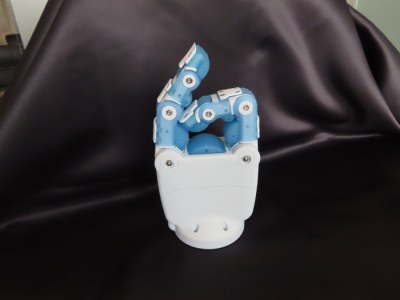
Example of application: Robotic hand
(the blue parts are made from Sumitomo Rubber Industries material)
In the development process, we carefully considered the optimal material formulation and printing parameters, and verified the flexibility, rebound resilience, and durability of printed objects. Currently we are considering ways to offer materials in combination with the printing process with equipment manufacturers and printing partners.
One of our strengths is that we can leverage our long-established rubber compounding and evaluation technologies to tailor the hardness and other properties to the application. We help customers bring the shapes and functions they want to life through an integrated process that includes everything from material development to considering the optimal printing parameters and evaluating performance.
If you have any inquiries about our 3D printing rubber, please contact us using this form.
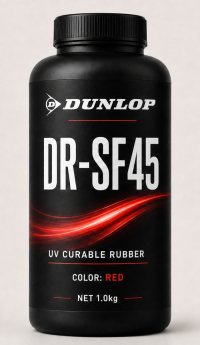
Retail resin bottle containing our 3D printing rubber
One of the most serious problems oyster farmers face is stunted growth and death of oysters caused by changes in the marine environment such as rising sea temperatures. For this reason, new options are needed to help the oyster farming industry adapt to environmental changes, as it is highly dependent on natural conditions.
In response, we are developing a system for floating and submerging rafts by inserting air into rubber floats attached to the bottom of the rafts. By submerging the oysters to a depth that is optimal for their growth, the system aims to adapt farms to higher sea temperatures and other environmental changes.
As part of the development process, we continue to test and make improvements by conducting countless interviews with aquaculture farmers and others in the seafood industry, creating prototype floats, and carrying out lifting and submerging experiments on small-scale rafts.
One of our strengths is our ability to design rubber materials with a focus on durability—which is essential for materials used in the ocean—and combine this expertise with a system that can stably lift and submerge the entire float. We are driving development centered on farming sites in collaboration with aquaculture farmers, universities, government agencies, and manufacturing partners.
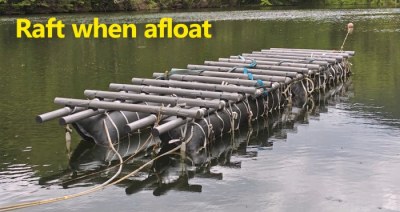
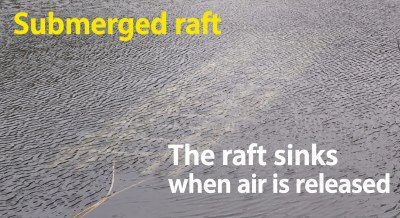
Overview of the oyster raft flotation system experiment
In coastal regions, older adults, people with limited mobility, and those far from a shelter risk not being able to evacuate to higher ground when a tsunami strikes. For this reason, a new way to increase survivability after a disaster is needed.
In response, we are developing an evacuation float with a focus on increasing the early survival rate when a tsunami strikes. We envision installing the floats in buildings and other structures in coastal areas, and are considering the optimal structure and utilization method with the aim of increasing options to protect people from tsunamis.
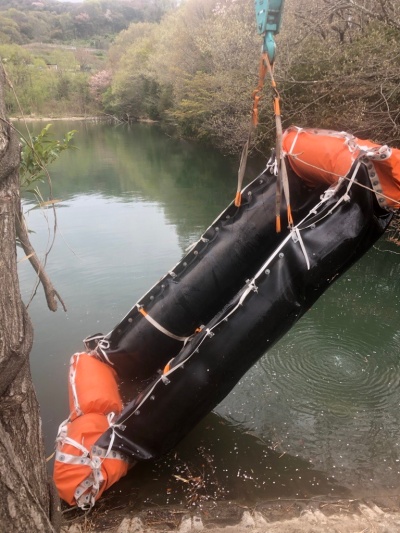
Prototype tsunami evacuation float
As part of the development process, we are considering the optimal specifications through discussion with educational institutions, disaster management experts, and government agencies. The prototype is undergoing tests to evaluate its stability on the water and other properties.
We will meticulously verify that it is safe enough to protect lives by leveraging our expertise in the shock-absorption properties and durability of rubber. We aim to implement the technology in real-world use in collaboration with educational institutions, experts, government agencies, and manufacturing partners.
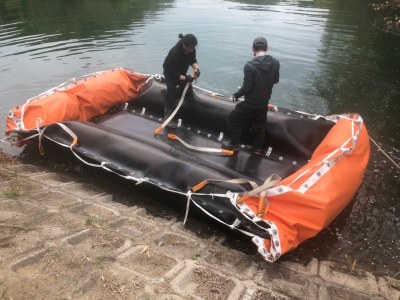
Tsunami evacuation float experiment
When a reservoir breaks during torrential rains, it impacts not only farms but also the communities who live downstream. In addition, the aging and shortage of farm workers have increased the workload for day-to-day water level management and drainage. For this reason, we need a system that not only identifies abnormalities but also prevents damage.
In response, we are developing a disaster management system that combines monitoring with cameras and water-level sensors and energy-efficient drainage pumps. Our aim is to both mitigate the management workload during ordinary times and take preventative measures during torrential rains by identifying changes in the water level and draining it when necessary.
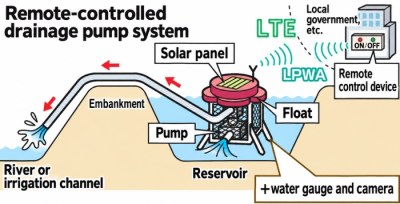
Diagram 1. Agricultural Reservoir Flood Control System
As part of the development process, we are talking to government agencies and reservoir managers to identify needs and carrying out repeated drainage tests with prototypes. We are considering portability, pipe cleaning functions, and service offerings that would include remote monitoring and operation, and preparing to conduct PoCs in Okayama and Hyogo prefectures.
Our strengths lie in our expertise in materials and structural design and our ability to offer monitoring, drainage, and remote operation as an integrated system. We aim to create a disaster management system that is easy to install and can be used continuously in collaboration with local governments, universities, local businesses, and engineering partners.
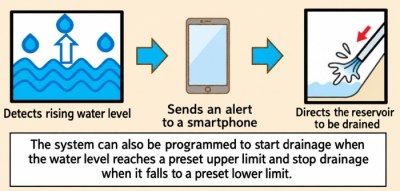
Diagram 2. Agricultural Reservoir Flood Control System
As electric mobility has become widespread, many issues have emerged such as how to make charging more convenient, reduce charging time, and decrease vehicle battery size. As a result, there is growing demand for infrastructure that can wirelessly supply vehicles with power while they are moving or stopped, without the need for cables.
In response, we are developing a system that will wirelessly transmit power to vehicles through sheet-type coils embedded in roads and floors. Our goal is to establish a surface material and construction method that take into consideration constructability, durability, and maintainability in addition to the power supply function.
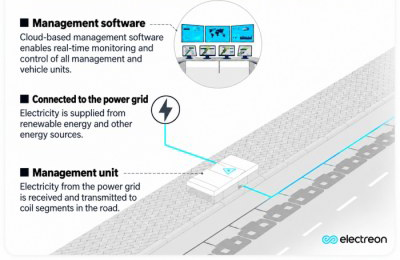
Wireless Power Transfer System 1
As part of the development process, we worked with external partners to study sheet-type coils, visited related companies and testing facilities in Europe, and researched market trends and technological issues. Currently we are leveraging our long-established paving and floor-coating technologies to consider the optimal construction method in preparation for practical implementation and explore the possibility of different applications.
Our strengths are our rubber and resin material compounding technologies and our ability to combine them with our knowledge of road and flooring construction technologies and durability evaluations. We aim to build a system that ensures the power supply equipment is protected while also taking into account ease of construction and repair, and implement it as part of the social infrastructure that will underpin the future of mobility.
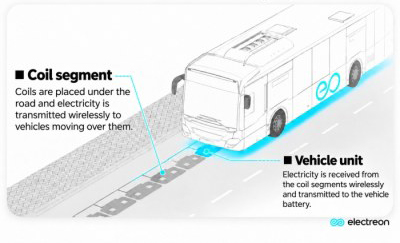
Wireless Power Transfer System 2
In aquaculture areas, rising sea temperatures and changes in oxygen and nutrient conditions affect the growth of aquatic organisms. In addition, clogging and energy consumption are issues when transporting water that contains earth and foreign matter with conventional pumps. That is why a simple fluid-transport technology that can be stably used in the ocean is needed.
Responding to this need, we are developing airlift pumps that send air into the pipes to lift water with rising air bubbles. With no rotating parts underwater, the pump is resistant to clogging caused by foreign matter, so we are considering using it for applications such as bringing up low-temperature water and nutrients near the seafloor, improving aquaculture environments, and removing sediment.
In the development process, we built a prototype jointly with universities and other companies, and confirmed its functionality in lab experiments and in the ocean. In addition, we verified the pump’s effects on the aquaculture environment by continuously operating it and acquiring water quality and environmental data in Tsukumo Bay in Noto, Ishikawa.
Our strengths are our ability to design rubber hoses compatible with negative pressure and marine environments and our collaborative testing and demonstration framework with universities and field partners. We will explore expanding into a wide range of applications besides aquaculture, such as removing sediment from dams and recovering seabed resources.
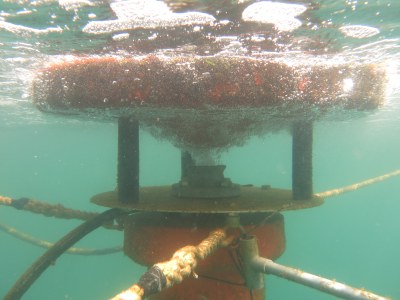
Airlift pump experiment
Floors of factories, logistics centers, data centers, and other facilities require specifications that are tailored to the purpose of the facility, such as durability, constructability, static electricity protection, and repairability. The challenge is to develop flooring solutions that support reliable equipment operation while minimizing maintenance and management burdens.
In response, we are considering solutions to equip flooring with functions tailored to each facility’s needs by combining resin materials and application techniques. We are exploring how to provide value in everything from materials to installation by identifying needs such as conductivity, durability, and rapid installation.
As part of the development process, we are exploring the North American market and identifying challenges faced by customers in the data center industry, while also considering ways to combine conductive flooring with vibration control. We are also researching the possibility of using protective and construction materials when installing wireless power transfer equipment in flooring.
One of our strengths is our ability to take an integrated approach to material formulation, adhesives, installation, and durability assessment. We aim to deliver proposals that will contribute to the safety and stable operation of facilities by considering not only the flooring itself but also related issues such as equipment protection and static electricity and vibration control.
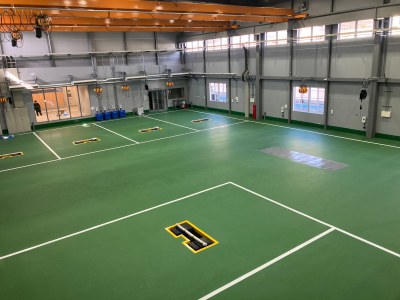
Example of a high-performance floor coating installation
The Innovation & Business Development Department is helping the Hybrid Business Headquarters explore the market to expand the headquarters’ floor material technology into the North American market.
When a major earthquake hits, buildings experience severe shaking and deformation, which can damage structural elements and internal and external equipment. For this reason, seismic control technology is needed to ensure the building is safe and its functions can be maintained and quickly restored after a disaster. And in high-rise buildings, shaking from strong winds can affect livability and work environments.
In response, we have developed and launched a seismic damper that efficiently absorbs energy created by earthquakes and strong winds. We are verifying its effectiveness through structural analysis and full-scale testing that considers the structural characteristics of buildings and other factors.
The Innovation & Business Development Department is helping the Hybrid Business Headquarters explore the market to expand the headquarters’ seismic control technology into the North American market.
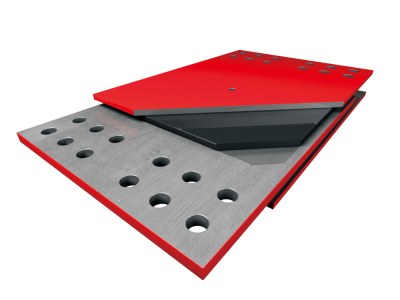
Seismic damper
In the development and launch process, we have expanded into the global construction market by leveraging our long-established seismic control and rubber material technologies. More recently, we have applied our damper to real-world projects and conducted technology demonstrations in collaboration with universities, architectural firms, and general contractors in countries with high needs for seismic control.
One of our strengths is that we can handle everything from design of materials that utilize the viscoelasticity of rubber, to damper design, to analysis and evaluation technology. We contribute to reducing building damage, improving safety, and ensuring business continuity by delivering performance that remains stable for many years.*
*Based on the results of accelerated aging testing conducted by Sumitomo Rubber Industries, Ltd. (on the high-damping rubber damper component).
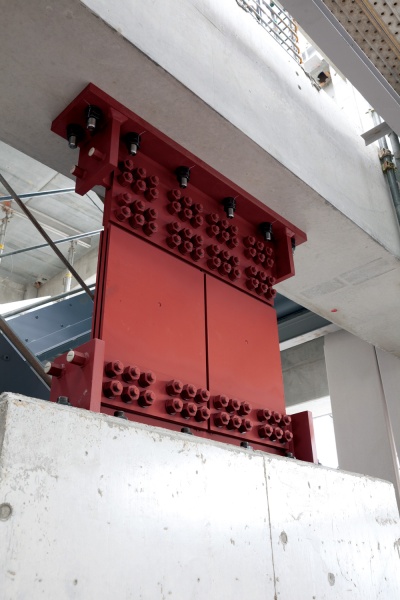
Example of an installed seismic damper
We tackle problems faced by customers and communities in a wide range of areas including environment and energy, life sciences, motion technology, and harsh environments. In addition to utilizing our own technology, we will co-create and conduct repeated proofs of concept with our diverse partners worldwide, with the aim of delivering new value that supports both daily life and industry to communities.
Please contact us here with inquiries about products from each project.