Six Research Results on Tire and Road Wear Particles Presented at Tire Technology Expo 2026: — Scientific Verification at Three Stages: Generation, Dispersal, and Accumulation
Mar. 05. 2026
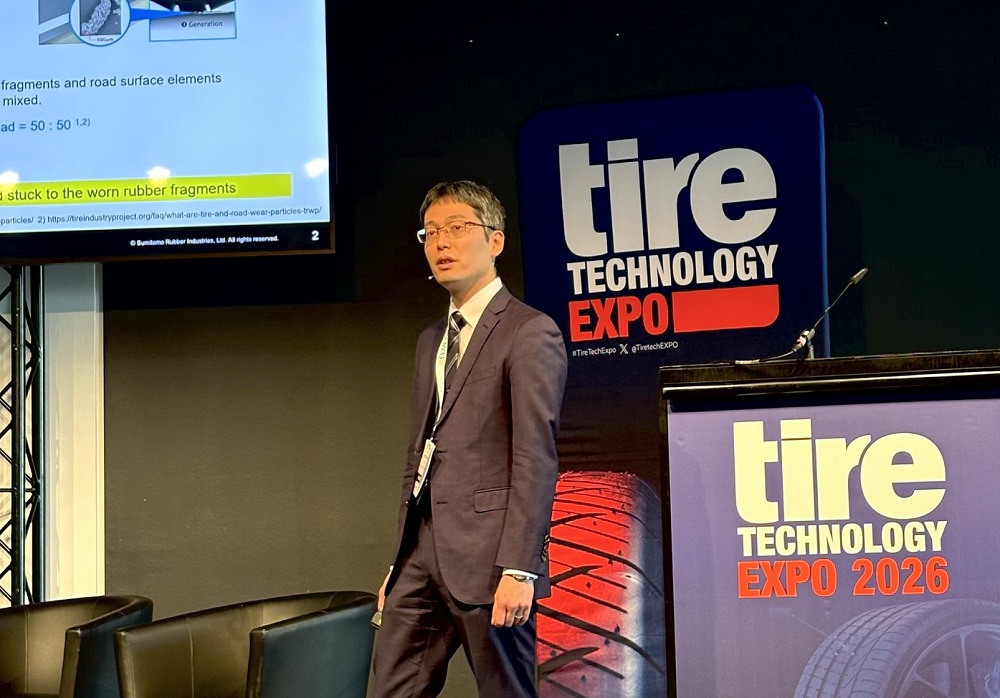
DUNLOP (Company name: Sumitomo Rubber Industries, Ltd.; President and CEO: Satoru Yamamoto) is pleased to announce that it presented six results of research on tire and road wear particles (TRWP)*1 at the Tire Technology Expo 2026, the world’s leading tire technology conference/exhibition, held in Hannover, Germany from March 3 to 5.
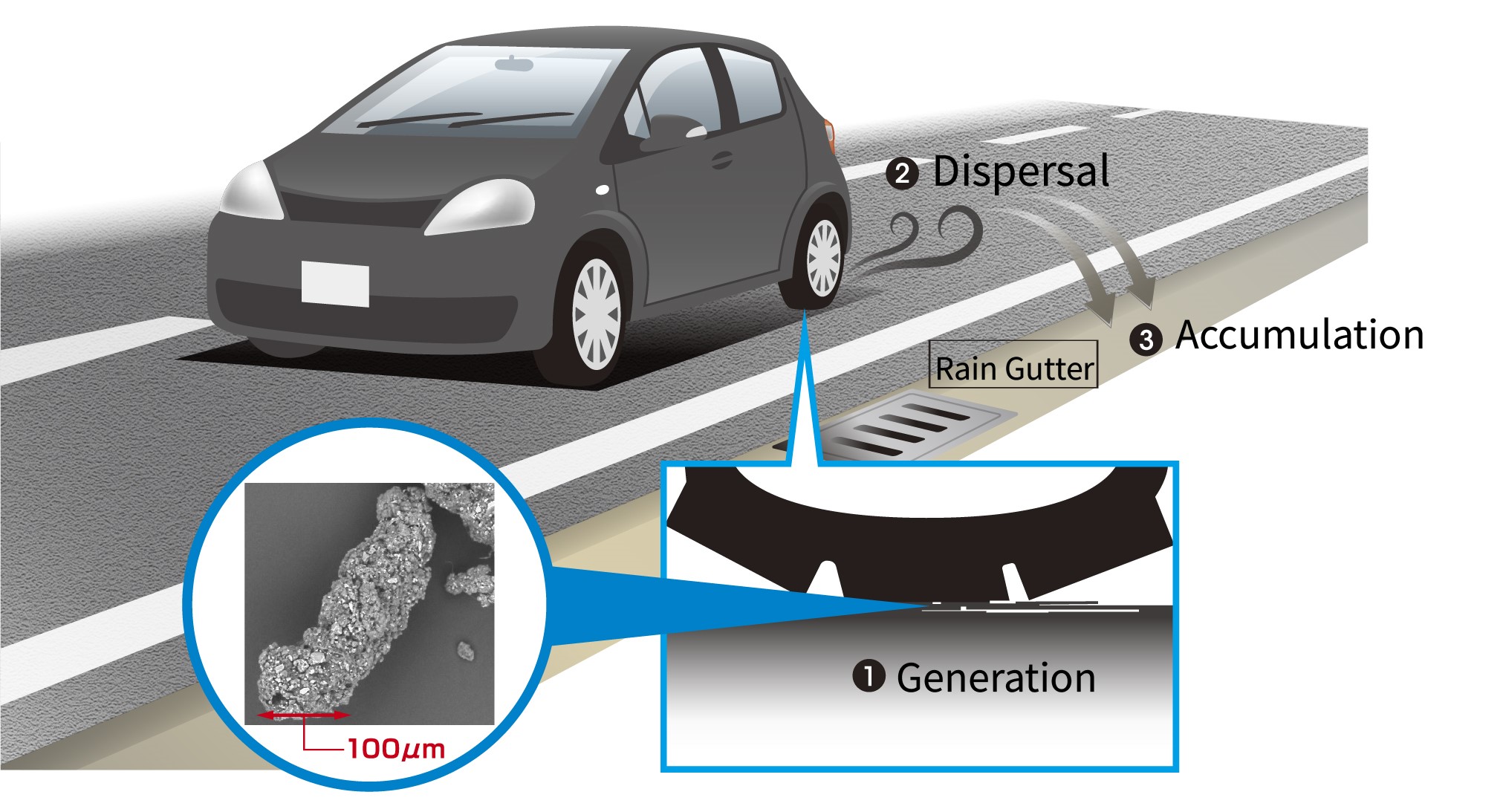
Recognizing the importance of understanding and reducing the environmental impact of TRWP, we have been advancing various initiatives to fulfill our social responsibilities as a tire manufacturer. We have been working to reduce TRWP generation by enhancing the wear resistance of tires, diligently addressing challenges through scientific data-driven approaches, and conducting surveys and research to reduce environmental impact focusing on the three stages of TRWP, namely (1) generation, (2) dispersal, and (3) accumulation. The results of these initiatives were disclosed as a news release in August last year.*2 Since then, we have continued to advance our initiatives by expanding the scope of research while collaborating with external research institutions and companies.
At the Tire Technology Expo 2026, we presented the findings and research results newly obtained at each stage of TRWP: (1) generation, (2) dispersal, and (3) accumulation.
■ Outlines of research results
* Research results 4 and 5 are related to each other, and the outline above includes both results.
These initiatives represent concrete efforts to address “Biodiversity,” one of the seven material issues*3 announced in October 2024. Research and mitigation efforts regarding the environmental impact of tire and road wear particles are included in the Long-Term Sustainability Targets: “Driving Our Future Initiatives 2050” *4 as well.
Many aspects of TRWP remain unclear, especially its environmental impact, which requires further research and validation. We have been participating in the TIP*5 of the WBCSD*6 since its inception, involved in activities such as research and studies on TRWP, the establishment of evaluation methods, and dialogues with stakeholders. We are also a member of the JATMA*7 and JRMA*8, working on developing ISO standards related to the assessment of TRWP and other efforts. We are committed to diligently addressing TRWP-related challenges through a scientific data-driven approach, in our efforts to reduce environmental impact and fulfill our social responsibilities.
Since 2026, we have unified our communication brand under DUNLOP.
DUNLOP embodies three core brand value propositions across all products and services: “Reliable support for every challenge,” “Experiences that exceed expectations,” and “Pushing beyond limits.” Through innovative experiences, we are committed to creating positive emotions for people around the world.
Our brand statement, “TAKING YOU BEYOND,” expresses our aspiration to broaden the possibilities of all who take on challenges and to continue guiding them forward.

<Reference>
Tire Technology Expo 2026 https://tiretechnology-expo.com/
DUNLOP’s presentation at the Tire Technology Expo 2026
Recognizing the importance of understanding and reducing the environmental impact of TRWP, we have been advancing various initiatives to fulfill our social responsibilities as a tire manufacturer. We have been working to reduce TRWP generation by enhancing the wear resistance of tires, diligently addressing challenges through scientific data-driven approaches, and conducting surveys and research to reduce environmental impact focusing on the three stages of TRWP, namely (1) generation, (2) dispersal, and (3) accumulation. The results of these initiatives were disclosed as a news release in August last year.*2 Since then, we have continued to advance our initiatives by expanding the scope of research while collaborating with external research institutions and companies.
At the Tire Technology Expo 2026, we presented the findings and research results newly obtained at each stage of TRWP: (1) generation, (2) dispersal, and (3) accumulation.
■ Outlines of research results
| (1) Generation | |
| (Understanding the formation mechanism of TRWP) | |
| Research result 1. Effect of plasticizers and resins on tire wear particle formation | |
| In joint research with Professor James Busfield at the Queen Mary University of London, we developed a new method for investigating how TRWP is formed by focusing on the chemical change that occurs on the tire surface during driving. In addition, we confirmed the possibility of controlling the size and composition of TRWP by changing the types and quantities of additives contained in tire formulations. These results are expected to contribute to mitigating the environmental impact of TRWP. Queen Mary University of London: https://www.qmul.ac.uk/ |
|
| Research result 2. Laboratory perspective for TRWP collection and detection | |
| In joint research with Dutch manufacturer VMI, we verified methodology for collecting/detecting TRWP during a laboratory abrasion test using rubber samples. As a result, we successfully developed a new technique capable of collecting/analyzing the wide-ranging sizes of TRWP. We will continue to understand the TRWP generation mechanism and develop novel technology for reducing its generation. VMI: https://vmi-group.com/ |
|
| (Mechanism and prediction of fatigue wear) | |
| Research result 3. Rubber fatigue and predictive testing of fatigue wear of tires | |
| We are working with Prof. Gert Heinrich of the Dresden University of Technology to study a new test method for quantitatively assessing the fatigue characteristics of rubber by focusing on “fatigue wear.” In this study, we analyzed the initiation and growth of fine cracks appearing in tire rubber on a relatively coarse road surface like concrete, and developed a model that enables more exact prediction of tire wear. This opened up a prospect for the establishment of a test method that can assess the durability and wear resistance of rubber materials in a short time. In addition, the investigation of the relation with rubber compounding properties will accelerate technology development aimed at improving wear resistance. Improving antiwear performance leads to the reduction of TRWP generation. Dresden University of Technology: https://tu-dresden.de/ |
|
| (2) Dispersal | |
| (Research to understand TRWP properties and reduce its dispersal) | |
| Research result 4. Active flow field design to capture tire wear particle | |
| Research result 5. Aerodynamics around the rolling tire for boundary layer determination | |
| We are working with Prof. Dr.-Ing. Falk Klinge, an aerodynamics expert at the Ostfalia University of Applied Sciences in Germany, to develop a TRWP collecting device that uses the flow of air produced around tires during vehicle operation. Recently, we successfully visualized the airflow three-dimensionally, including the flow component in the tire width direction, by improving the visualization device. Additionally, on the basis of this three-dimensional flow information, we studied the optimization of the mounting angle of the collecting device, experimentally demonstrating the feasibility of the aerodynamic TRWP collecting device. Going forward, we will pursue the optimization to improve the TRWP collection rate and aim to conduct an actual vehicle test in 2028. Ostfalia University of Applied Sciences: https://www.ostfalia.de/en |
|
| (3) Accumulation | |
| (Separation and quantitative analysis of TRWP and microplastics in the environment) | |
| Research result 6. A study on separation methods for TRWP and typical microplastics | |
| Not only TRWP but also microplastics are emitted into the environment, and the amounts of their emissions have been estimated in various ways. In joint research with Associate Professor Shuhei Tanaka at Graduate School of Global Environmental Studies, Kyoto University, we found the possibility of part of the microplastics emissions being missed. In road dust collected at crossings in Kyoto City, we found not only TRWP but also a large amount of microplastics smaller than 300 μm, which had been missed in the past analyses, even in heavy components such as soil and sand. Having the correct understanding of where in the environment TRWP and microplastics are accumulated as well as their quantities can be important knowledge to prevent and mitigate the dispersal and accumulation of TRWP. We will continue to collect these data. Graduate School of Global Environmental Studies, Kyoto University: https://www.ges.kyoto-u.ac.jp/en/ |
|
These initiatives represent concrete efforts to address “Biodiversity,” one of the seven material issues*3 announced in October 2024. Research and mitigation efforts regarding the environmental impact of tire and road wear particles are included in the Long-Term Sustainability Targets: “Driving Our Future Initiatives 2050” *4 as well.
Many aspects of TRWP remain unclear, especially its environmental impact, which requires further research and validation. We have been participating in the TIP*5 of the WBCSD*6 since its inception, involved in activities such as research and studies on TRWP, the establishment of evaluation methods, and dialogues with stakeholders. We are also a member of the JATMA*7 and JRMA*8, working on developing ISO standards related to the assessment of TRWP and other efforts. We are committed to diligently addressing TRWP-related challenges through a scientific data-driven approach, in our efforts to reduce environmental impact and fulfill our social responsibilities.
Since 2026, we have unified our communication brand under DUNLOP.
DUNLOP embodies three core brand value propositions across all products and services: “Reliable support for every challenge,” “Experiences that exceed expectations,” and “Pushing beyond limits.” Through innovative experiences, we are committed to creating positive emotions for people around the world.
Our brand statement, “TAKING YOU BEYOND,” expresses our aspiration to broaden the possibilities of all who take on challenges and to continue guiding them forward.
| *1 | Fine particles generated by friction between tires and the road surface while the car is running. They are primarily a mixture of tire tread materials and road-pavement materials. |
| *2 | Results of Initiatives to Reduce Tire and Road Wear Particles Presented at Conferences in Japan and Abroad (News release issued August 29, 2025) https://www.srigroup.co.jp/english/newsrelease/2025/sri/2025_065.html |
| *3 | Material Issues: https://www.srigroup.co.jp/english/sustainability/materiality.html |
| *4 | Long-Term Sustainability Targets: “Driving Our Future Initiatives”: https://www.srigroup.co.jp/english/sustainability/challenge2050.html |
| *5 | TIP: The Tire Industry Project / Industry group consisting of 10 global tire manufacturers |
| *6 | WBCSD: The World Business Council for Sustainable Development |
| *7 | JATMA: The Japan Automobile Tyre Manufacturers Association, Inc. |
| *8 | JRMA: The Japan Rubber Manufacturers Association |
<Reference>
Tire Technology Expo 2026 https://tiretechnology-expo.com/