The DUNLOP Group regards each and every employee as important human capital and a source of corporate value creation. We promote Health and Productivity Management as an important initiative within Human Capital Management, aiming to improve safety, quality, and productivity and to achieve well-being by maintaining and promoting the health of employees and their families.
The Company's health management function, the SRI Health Insurance Society, and the labor union work together to promote Health and Productivity Management across the Company through health meetings and collaborative health initiatives*1.
We identify and analyze health issues using data from health checkups, stress checks, presenteeism, engagement, and other indicators, and implement priority measures. We evaluate progress and outcomes using KGIs and KPIs, review measures based on the results, and pursue continuous improvement through the PDCA cycle.
In recognition of these initiatives, we have been certified as a Health & Productivity Management Outstanding Organization*2 for nine consecutive years since 2017, and were selected as a Health & Productivity Stock Selection*3 company in 2020 and 2022. We have also been certified as a Sports Yell Company*4 for three consecutive years.

※1Collaborative health initiatives: Initiatives in which a company and its health insurance society, among others, work together to effectively promote the health of insured members.
※2Health & Productivity Management Outstanding Organizations Recognition Program: A program that recognizes corporations, including large enterprises and SMEs, that practice particularly outstanding Health and Productivity Management, based on initiatives addressing regional health issues and health-promotion initiatives advanced by the Nippon Kenko Kaigi.
※3Health & Productivity Stock Selection: A program jointly conducted by the Ministry of Economy, Trade and Industry and the Tokyo Stock Exchange to select particularly outstanding listed companies that consider employee health management from a management perspective and address it strategically.
※4Sports Yell Company: A certification by the Japan Sports Agency for companies that actively promote employee participation in sports to improve employee health. A Plus (+) certification is granted to companies where at least 70% of employees participate in sports at least once a week.
In accordance with “Our Philosophy,” the DUNLOP Group recognizes each and every employee worldwide as its most valuable capital and the fundamental source of corporate value creation.
The “health” we pursue extends beyond the mere absence of illness and encompasses a state of complete physical, mental, and social well-being. Based on this understanding, we are committed to advancing initiatives that safeguard and enhance the health of our employees and their families.
Furthermore, a highly engaged organization—where individuals respect and trust one another and work with vitality—is an essential component of the “health” we strive to achieve. Such engagement also serves as a key driver of sustainable growth and long-term competitiveness.
The DUNLOP Group positions the enhancement of employee health and engagement as a critical management priority. We are dedicated to fostering an environment in which all employees can fully realize their potential and proactively contribute to value creation.
Through these efforts, we aim to deliver “the highest level of safety and excitement” to society.
As part of our commitment to “Our Philosophy,” all members of the DUNLOP Group, together with their families, will continue to work collectively to promote health and productivity management.
March 26,2026
Sumitomo Rubber Industries,Ltd.
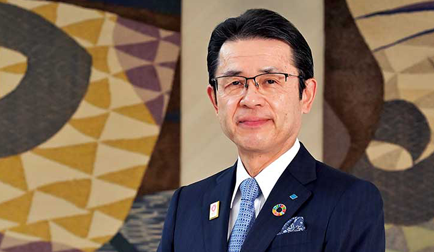
Yasuaki Kuniyasu
President and CEO
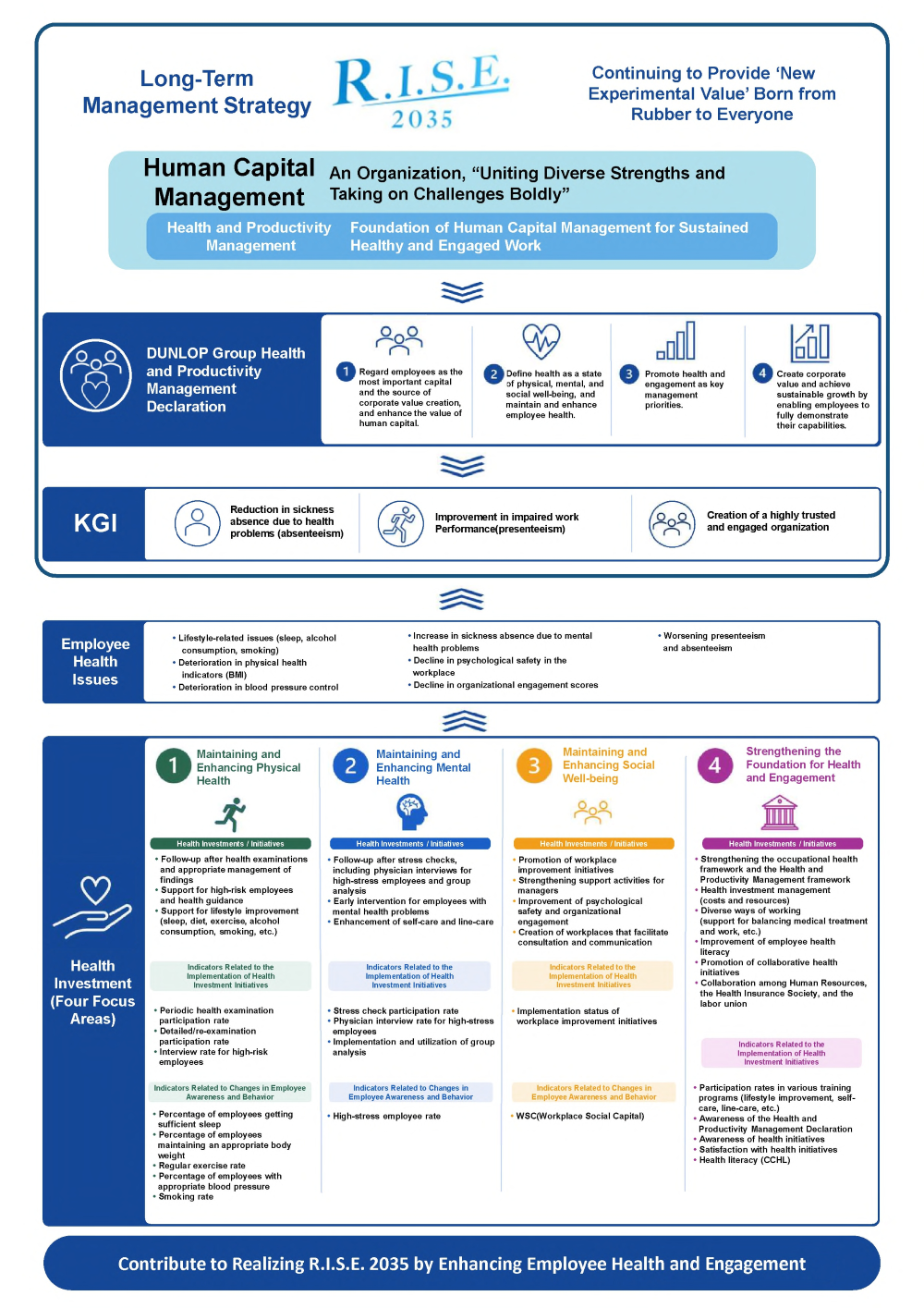
To continuously improve Health and Productivity Management, we have established the following long-term priority goals and focus areas.
[Long-term Priority Goals]
1. Strengthen Health and Productivity Management
Building on an occupational health framework that supports legal compliance, we will strengthen Health and Productivity Management through the analysis of health-related indicators, identification of health issues, implementation of priority measures, verification of effectiveness through KPIs, and continuous improvement.
2. Foster a Culture of Health
We will improve health literacy and embed Health and Productivity Management throughout the organization, fostering a culture in which people “take action to improve their own health” and “care about one another’s health,” thereby improving both health and engagement.
[Focus Areas]
① Mental well-being: Prevent mental health problems, enable early detection and early intervention, and strengthen workplace management
② Physical health: Follow-up after health checkups, prevention of serious illness, lifestyle improvement, and smoking cessation support
③ Social (Workplace and Organization): Improve engagement and create a supportive workplace based on trust and cooperation.
④ Health culture and Management foundation: Analyze issues based on health-related indicators, manage KPIs, conduct management reviews, and promote Health and Productivity Management through collaborative health initiatives
| Indicator | Definition | Unit | 2023 | 2024 | 2025 | 2026Target |
|---|---|---|---|---|---|---|
| Sickness absence rate (absenteeism) | Percentage of workdays lost due to illness | % | 0.93 | 0.85 | 0.82 | 0.85 |
| Mental-health-related sickness absence rate | Percentage of workdays lost due to mental health problems | % | 0.56 | 0.54 | 0.50 | 0.50 |
| Presenteeism (WFun) | Indicator of impaired work functioning due to health problems | - |
C-rated workplaces: 2 Moderate-to-severe work functioning impairment: 18.5% |
C-rated workplaces: 3 Moderate-to-severe work functioning impairment: 19.5% |
C-rated workplaces: 4 Moderate-to-severe work functioning impairment: 19.0% |
C-rated workplaces: 3 Moderate-to-severe work functioning impairment: below 18% |
| Engagement | Indicator of employees’ affinity with the organization, sense of fulfillment at work, etc. | % | - | - | 41 | 45 |
| Area | Indicator | Definition | Unit | 2023 | 2024 | 2025 | 2026Target |
|---|---|---|---|---|---|---|---|
| Mental well-being | Stress check participation rate | Percentage of employees completing the stress check | % | 95.6 | 98.3 | 98.3 | 100 |
| Number of Stress Check Participants | Number of Employees Who Completed the Stress Check | people | 7662 | 7546 | 7590 | - | |
| High-stress employee rate | Percentage of employees identified as highly stressed | % | 14.0 | 14.0 | 13.4 | 12.5 | |
| Physician interview rate for high-stress employees | Percentage of high-stress employees receiving a physician interview | % | - | - | 61.6 | 80.0 | |
| Line-care training completion rate (annual) | Percentage of managers completing line-care training | % | 23 | 65 | 55 | 95.0 | |
| Physical health | Periodic health examination participation rate | Percentage of employees receiving periodic health examinations | % | 100 | 100 | 100 | 100 |
| Detailed examination participation rate | Percentage of employees requiring detailed examinations who receive them | % | 83.4 | 87.1 | 75.8 | 85.0 | |
| High-risk employee interview rate | Percentage of high-risk employees receiving interview guidance | % | 57.0 | 71.7 | 59.7 | 75.0 | |
| Rate of employees with abnormal health examination findings | Percentage of employees with abnormal findings in health examinations | % | 53.0 | 52.5 | 51.9 | 50.0 | |
| Smoking rate | Percentage of employees who smoke | % | 36.6 | 35.2 | 34.4 | 34.0 | |
| Regular exercise rate | Percentage of employees with regular exercise habits | % | 25.0 | 25.6 | 25.0 | 27.0 | |
| Percentage getting sufficient sleep | Percentage of employees responding that they get sufficient sleep | % | 61.1 | 60.7 | 55.2 | 70.0 | |
|
Social (workplace/organization)
|
Workplace social capital | Indicator of trust, cooperation, and mutual support in the workplace | Score | 3.7 | 3.7 | 3.7 | 3.8 |
| Work engagement | Indicator of employees’ vigor, dedication, and absorption in their work | Score | 2.4 | 2.4 | 2.2 | 2.4 | |
| Health culture | Awareness of the Health and Productivity Management Declaration | Percentage of employees aware of the declaration | % | 50.9 | 53.8 | 58.1 | 70.0 |
| Awareness of health initiatives | Percentage of employees aware of health initiatives | % | 54.5 | 53.9 | 55.8 | 65.0 | |
| Satisfaction with health initiatives | Percentage of employees satisfied with health initiatives | % | 47.6 | 46.8 | 50.6 | 65.0 |
We analyze data from health checkups, stress checks, presenteeism, engagement, and other sources to identify employee health issues and workplace/organizational issues. Based on the results, we clarify priority issues and target workplaces and use the findings to plan and implement effective measures.
In addition to providing consultations, physician interviews, and other support for high-stress individuals, we use group analysis of stress-check results and workplace interviews to improve the work environment. We also provide line-care training for managers and supervisors to prevent mental health problems and promote early detection and early intervention.
While workloads are increasing due to business expansion and other factors, we are improving operational efficiency and hiring additional staff to curb increases in working hours. To tackle long working hours, we notify employees who have worked 80 hours or more of overtime in a month (as gauged from login records or using other methods) of their overtime status and arrange an interview for them with an occupational physician so that they can receive guidance. For employees experiencing heavy workloads due to frequent overtime or weekend work, managers hold one-on-one meetings with them to develop improvement plans, and the personnel department monitors progress with implementation of the plan. In this way, we are endeavoring to prevent long working hours.
While maintaining a 100% participation rate in periodic health examinations, we encourage employees requiring re-examinations or detailed examinations to receive them, provide health guidance, and support continuity of treatment to promote early detection of disease and prevent conditions from becoming serious.
We provide information, health-promotion programs, and individualized support to improve lifestyle habits such as exercise, sleep, diet, alcohol consumption, and smoking. In cooperation with the SRI Health Insurance Society, we also support employees in taking proactive steps to improve their own health.
To enable employees to balance medical treatment and work with peace of mind, occupational physicians, occupational health nurses, the employee’s department, and Human Resources work together to provide work accommodations and return-to-work support tailored to each individual’s circumstances.
We identify health issues according to the age, life stage, and working environment of diverse employees, including older employees, women, and employees assigned overseas, and provide the necessary information and support.
We identify and analyze health issues, set priority issues and targets, and implement measures. We continuously evaluate effectiveness based on KGIs, KPIs, and feedback from workplaces, and use health meetings to determine improvement measures and drive continuous improvement.
Going forward, we will strengthen the use of health-related indicators and establish mechanisms to assess not only the implementation of initiatives, but also their effects on employee health and workplaces/organizations.
We will also clarify the respective roles of the Company and the DUNLOP Health Insurance Society and identify priority measures based on health issues, target populations, feasibility, and return on investment. Using the framework established in Japan as a foundation, we will explore opportunities to expand it to Group companies.